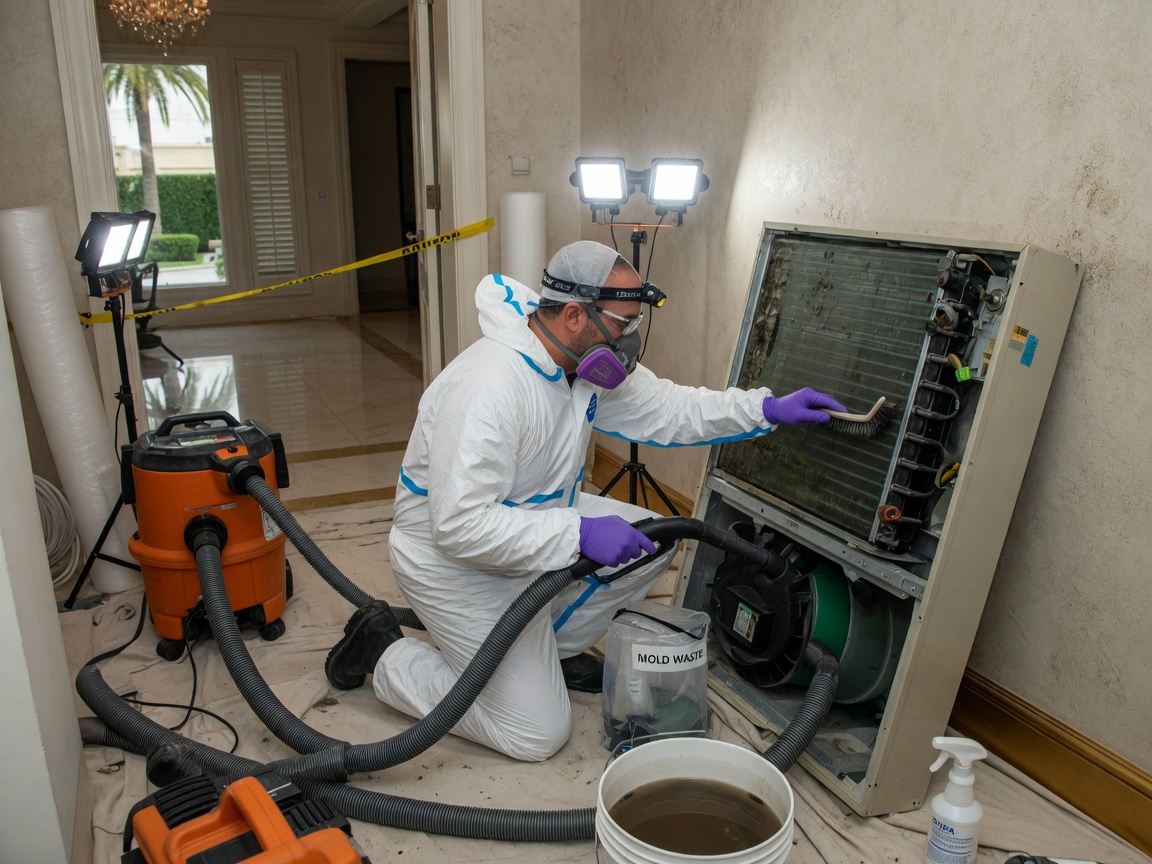
Beverly Hills homes built before 1970 in areas like Trousdale Estates and the Beverly Hills Flats often feature older forced-air systems with metal ductwork that traps moisture from the region's cool nights. When warm days meet these temperature swings, condensation forms inside supply lines and on evaporator coils, creating hidden mold colonies that standard filter changes miss. Remediation requires isolating the system, removing contaminated insulation, and applying EPA-registered antimicrobials that penetrate seams without damaging the original duct material.
In neighborhoods near Greystone Mansion or Beverly Hills City Hall, many properties sit on sloped lots where roof leaks or poor attic ventilation feed water into return plenums. HVAC mold remediation here includes negative-air machines to prevent spores from migrating into living spaces during removal. Technicians must also check for code compliance with Los Angeles County mechanical codes on duct sealing before reinstalling insulation, because unsealed joints allow future moisture intrusion from the mild but humid coastal air.
Properties along Rodeo Drive or in the Post Office area frequently have rooftop units exposed to the sun, which can overheat coils and accelerate mold growth when the system cycles off at night. Remediation crews use borescopes to inspect bends and transitions that standard visual checks overlook, then perform coil cleaning followed by fogging treatments. This approach prevents cross-contamination into adjacent homes in West Hollywood or Culver City when shared walls exist.
Technician insight
In Beverly Hills, the thing that catches most people out with HVAC Mold Remediation is condensation inside attic ducts in pre-1960 homes around the Golden Triangle. The mild Mediterranean climate with cool nights creates daily temperature swings that standard maintenance never addresses, so mold returns within two seasons if the insulation is not replaced.
Golden Triangle Home with Recurring Musty Odor
A homeowner in the Golden Triangle noticed musty air only when the AC ran at night. Inspection revealed heavy mold on return duct insulation caused by roof runoff entering the attic. We isolated the system, removed the contaminated sections, treated the coils, and replaced insulation with sealed material. The odor disappeared and follow-up sampling showed no elevated spores.
HVAC Mold Remediation Services We Offer
✓Ductwork Mold Removal
Removes visible and hidden mold from supply and return ducts using HEPA vacuuming and antimicrobial application in older Beverly Hills homes.
✓Evaporator Coil Remediation
Cleans and treats coils in attic or rooftop units to eliminate biofilm that forms from nightly condensation in the Mediterranean climate.
✓Attic Duct Insulation Replacement
Removes contaminated insulation around ducts and installs new material that meets current Los Angeles County energy codes.
✓Whole System Sanitization
Applies fogging agents throughout the HVAC system after physical cleaning to address residual spores in hard-to-reach plenums.
✓Return Plenum Mold Treatment
Targets mold growth in return air boxes common in mid-century homes near Beverly Gardens Park caused by roof runoff.
HVAC Mold Remediation Cost in Beverly Hills, CA
| Service | Typical Range | What Affects It |
|---|---|---|
| Initial HVAC Inspection | $200–$350 | Includes camera scan and moisture mapping; higher for multi-story homes in Trousdale Estates. |
| Duct Remediation | $900–$2200 | Varies with linear feet of duct and access difficulty in older Beverly Hills Flats homes. |
| Coil Cleaning and Treatment | $450–$750 | Rooftop units near the Beverly Hills Hotel often require extra equipment. |
| Insulation Replacement | $600–$1400 | Depends on attic accessibility and current code requirements. |
Ranges are typical for Beverly Hills, CA and confirmed with an exact written quote before any work starts.
How it works
- 1
System Assessment
Technicians inspect the full HVAC layout using cameras and moisture meters to locate all affected sections in the specific home layout.
- 2
Containment Setup
Negative pressure zones and plastic barriers isolate the HVAC system from living areas before any removal begins.
- 3
Physical Removal
Contaminated duct sections, insulation, and coil debris are extracted and bagged for off-site disposal.
- 4
Treatment and Drying
Antimicrobial solutions are applied and the system is dried with dehumidifiers before reassembly.
- 5
Verification and Restart
Post-treatment air sampling confirms clearance and the system is returned to normal operation.
Pricing
Costs depend on system size, number of affected zones, and whether insulation replacement is required.